Squirrel Picnic

Handmade with Love and Stuff


10 Comments

Field Trip: Beading with Sylvie

Hodge and Podge and Beads

Hodge and Podge help me pick out beads for my necklace.

Earlier this month, Hodge and Podge and I went on a field trip to visit my friend Sylvie Abecassis who was kind enough to teach us how to make a rosary link necklace. Sylvie and I had attended the Rocky Mountain Bead Show last April, where I came upon the mother load of vintage Bakelite beads and buttons. I couldn’t help myself from buying as much as I could carry. A lot of the beads were rather large and I was having trouble visualizing what I would make from them. As much as I love big jewelry, I wasn’t really keen on looking like Wilma Flinstone either.

Sylvie had the perfect solution: rosary links. So I showed up with squirrel friends, cheesecake, and beads, and we set out to tackle my necklace. Sylvie, always the generous artist, gave me the flat yellow beads from her collection. They’re so pretty!
Rosary Wire Technique

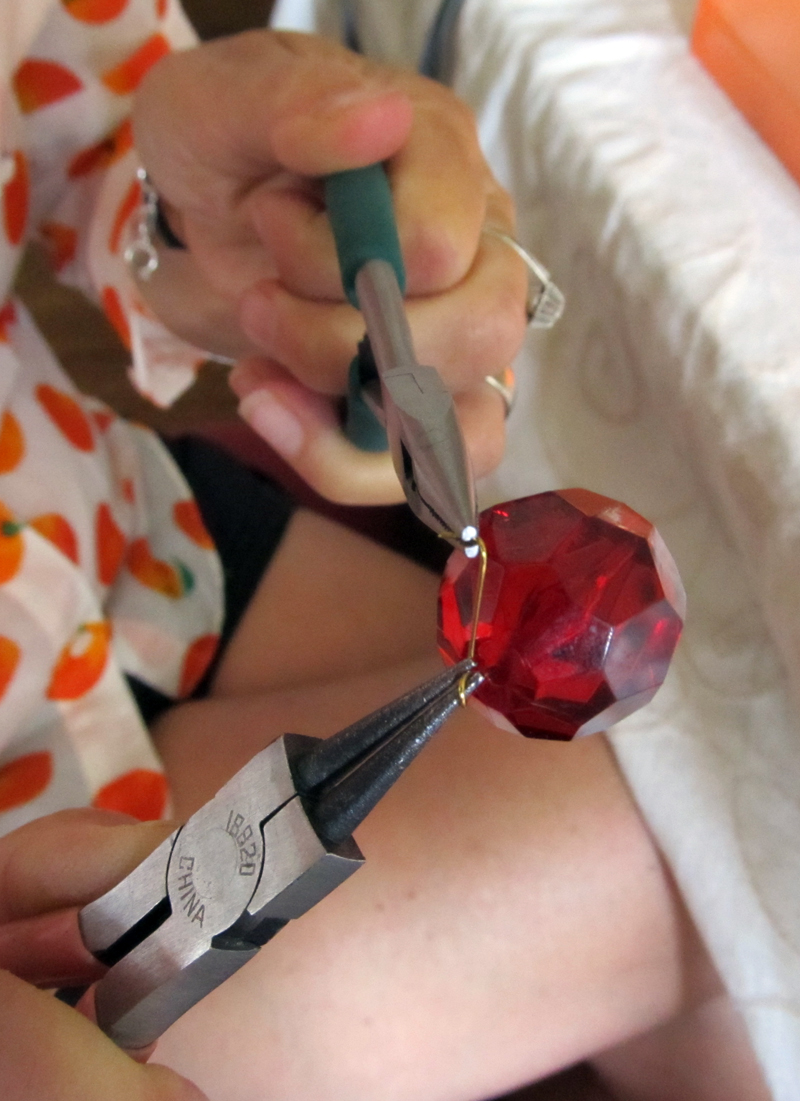
Sylvie shows me how to wrap the wire.

After we had the beads picked out and arranged, Sylvie began to show me how to string them together using the rosary chain link method. The tools you need are jewelry wire, round-nose pliers, flat-nose pliers, and flush wire cutters. You start by cutting a piece of wire an inch or so longer than the length of your bead. About an inch from one end, fold the wire at a 90-degree angle. Using the round-nose pliers, curl the shorter end of the wire up and around to form a loop. Then you change your hand position so that you are grasping the loop with one pair of pliers, and with another pair, coil the end of the short length under and around the longer wire two or three times. Trim any excess as close as you can. Then you add your bead and repeat on the other side. The tricky part comes with your next loop: I kept forgetting to link the new loop to the loop on the bead I had just completed. I ended up with a lot of empty chains! I called them practice chains. I’ll leave the demonstration of this technique to the experts: here’s a fabulous tutorial by Kathy of Katalina Jewelry.

Hodge and Podge mind the beads while I work on my wire-wrapping skills.

Hodge and Podge mind the beads while I work on my wire-wrapping skills.

Unfortunately, using all of these beads together created a really heavy necklace, so I decided to make a rosary chain with round black glass beads for either side of the necklace. I used a single loop rosary link on these instead of the wrapped rosary link I used on the larger beads. Time will tell whether or not this is strong enough.

I ended up making a pretty substantial necklace, didn’t I? I reserve the right to revisit this project later, when I’ve become better at these techniques. I may take off some of the larger beads. Maybe I’ll add some of the smaller beads. Maybe I’ll just start over. Or maybe in time, I’ll decide that this necklace is perfect just the way it is. That seems to be one of the great things about this technique. If you want to change something later on, it’s as simple as clipping off the unfavorable portion and connecting a new bead. You don’t have to take apart an entire strand.

The finished necklace.

The finished necklace.

Do you ever pull out your old projects and redo parts of them as you get better at a skill?  I take it as a sign of growth to be able to go back to something and make it better. It’s all part of the learning process, and it’s one of the elements of crafting that I love most. The more that you create and the more that you practice, the better you get at it. Even if you mess up, it’s virtually impossible not to learn from the experience.

I encourage everyone to try different crafts now and then, and never shy away from learning new things. I wonder how I will use what I’ve learned through jewelry making in my crochet and knitting. I don’t know, but I can’t wait to find out!

Above all else, I feel very blessed to have great friends like Sylvie to teach me new skills and guide me along the way. Thanks, Sylvie, for a wonderful afternoon!


23 Comments

Cuddly Robot Crochet Pattern

This slideshow requires JavaScript.

Introducing the newest resident of Squirrel Picnic… MEAP! This cuddly little robot made his debut in the Squirrel Picnic comic last weekend. Now I’m providing the pattern so you can make a robot too. And you may not know it yet, but you need a robot. Your cuddly robot can help you in many ways. He’s great for dusting the house and mopping up spills. Glue on a magnet and he can mind your small tools, metal parts, and trinkets. He can even cheer you up when you are sad or just look cute on your desktop.

Crochet MEAP the Robot Pattern Continue reading


22 Comments

SQUIRREL PICNIC (the comic): New Friends

Previous Episode: Welcome Party for Eric

Episode 2_1

After hiking down a hill and through a glen, over a bridge and across a meadow, Podge arrives at Eric’s laboratory with the welcome basket from everyone at Squirrel Picnic. She rings the bell on a massive door at the base of an oak tree… Continue reading


6 Comments

Knit and Crochet on the Go

You may find it interesting to know that I don’t spend my days playing with yarn. As much as I would love to do that, I need a full-time job to support my yarn habit. I work in the editorial department of a greeting card company and do most of my knitting and crocheting on my two-hour round trip commute. And don’t worry, although I once saw a driver knitting behind the wheel, I’ve never tried it. I’d rather take the bus.

Anyone who’s traveled with a yarn project can tell you the importance of having a good kit to hold your project and supplies. Whether you’re commuting by bus like I am or you’re packing for a summer vacation, here are some articles to help you get organized so you can take your skills on the road, and read on to find out about the kit I finally chose. Continue reading


16 Comments

Make It! Challenge #6: Jack Russell Clutch

Jack Russell Clutch For Make It! Challenge #6, Ranee Galambos challenged me to make a purse inspired by her favorite pet, a Jack Russell terrier named Nina.

“I loved her energy, devotion, intelligence and her company. She was the most amazing dog I ever owned and always made me laugh at her craziness,” Ranee said.

It was my pleasure to design this clutch inspired by such a wonderful furry friend.

I was excited to start this project because I knew it would be a great opportunity to try my hand at felting. I did some research and asked tons of questions, and now I’m ready to tell you all about this very fun and interesting technique that will make your clutch soft and cuddly as well as beautiful.

First, I stopped by my local yarn shop to hear what the experts had to say. When I went straight to the bright white wool, they stopped me and graciously advised that you shouldn’t use bleached white wool for felting because the bleaching process has damaged the fibers. Also superwash or washable wool will not felt. The higher the wool content, the better felted the final piece will be.

More helpful advice came from Kiki and Steven of Luscious Gracious. I recommend checking out their “Murphy’s Laws of Felting,” which provides pretty much everything you need to know. Most importantly, I learned that in felting, a knitted piece will shrink more in height than it does in width. With this in mind, I made a swatch first and recorded the size before and after washing it three times in a top-loading washing machine set to “Whites.” Would you believe that my swatch shrank 20% horizontally and 45% vertically? It made me really glad that I had taken the time to do this test! Designing the pattern 20% wider and 45% taller was a little tricky and the dog that I knit does look a little wonky, but thankfully the dog I pulled out of the final wash had shrunk to the exact size I had anticipated.

Therefore, the best advice I have for you is to make a swatch and wash it in the same manner that you will use to wash the clutch. Record the setting you use and the number of washes it takes to get the level of felting you desire. Then use that information to guide you at the felting stage, because even if you use the same yarn I have used, you’ll most certainly have a better washing machine than the ancient one I used in the basement of our apartment. Most likely yours will take less than three washes!

Jack Russell Clutch Continue reading